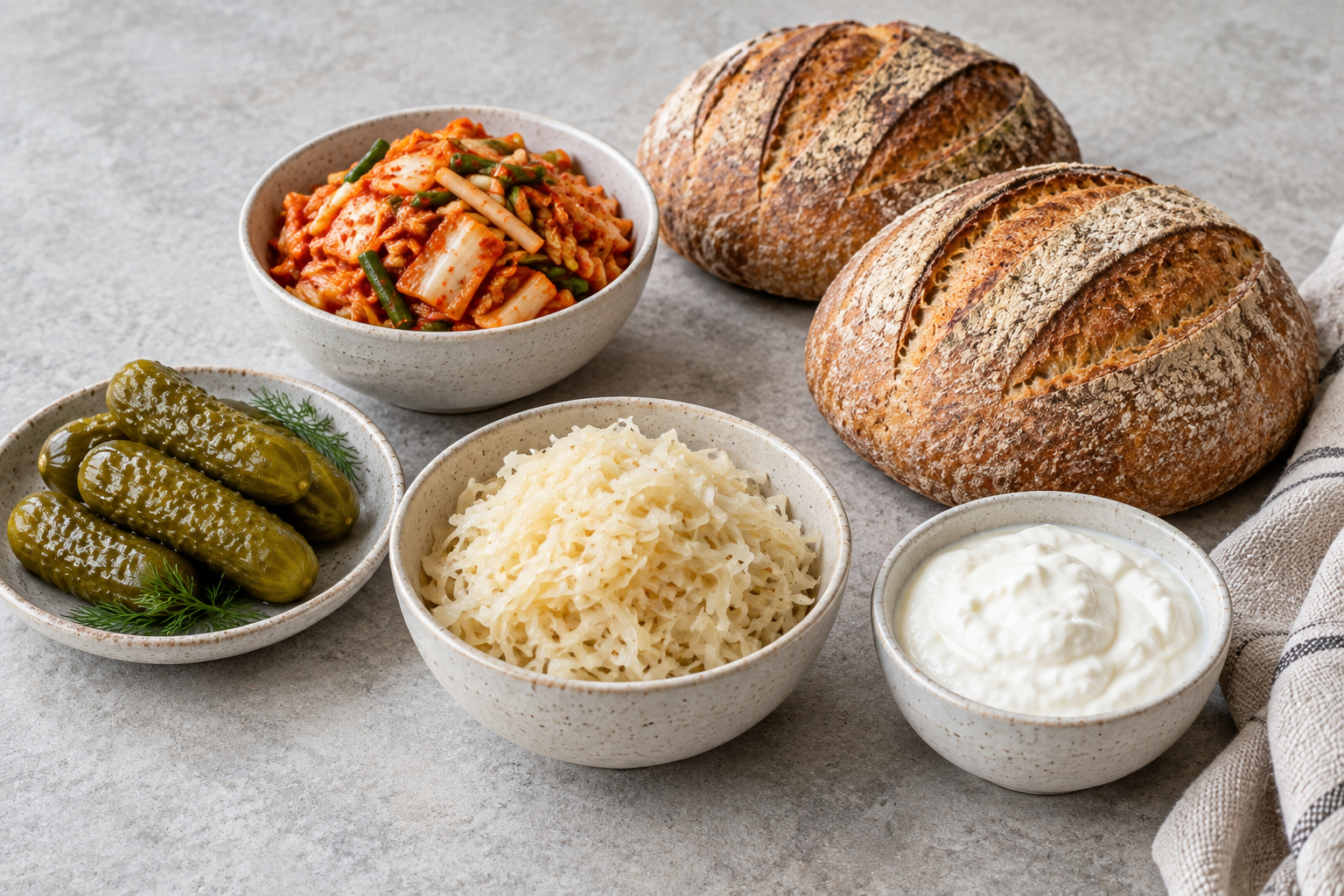
Choose a project for the food you want to make and the controls you can follow. These five published preparations replace the earlier unsourced seasonal jar formulas: sauerkraut, fermented dill pickles, refrigerated kimchi, cultured yogurt and sourdough bread. Each has its own process; none uses a universal spoonful of salt or a shared fermentation clock.
Compare before buying equipment
| Project | Starting batch | Main equipment and finish |
|---|---|---|
| Sauerkraut | Published 5 lb working portion | Suitable fermentation vessel, cover and weight; refrigerate fully fermented food |
| Dill pickles | 4 lb cucumbers per gallon vessel capacity | Suitable cover and weight; follow exact salt, vinegar and water |
| Kimchi | Two cabbage heads, about 6-8 lb | Food-safe refrigerator container with expansion room |
| Yogurt | 1 gallon milk plus culture | Thermometer, yogurt maker, pH measurement; refrigerate promptly |
| Sourdough bread | Established starter; two medium loaves | Mixing bowl, proofing bowls, Dutch ovens and food thermometer |
Read the linked original protocol before starting. These are ingredient and method summaries for choosing and making the published food; they are not a canning guide. Shelf-stable storage needs its own complete tested process. Do not reduce fermentation salt or swap vegetables on the assumption that any bubbling jar is equivalent.
For the cabbage and pickle recipes, follow NCHFP’s container and weight instructions : use clean food-grade equipment, keep vegetables 1-2 inches under brine, insert a suitable plate and weigh it down with 2-3 sealed quart jars of water, then cover with a clean heavy towel. Wash equipment in hot soapy water and rinse well with very hot water before use. A weight holds vegetables below liquid; a lid alone does not do that.
1. Sauerkraut: cabbage with a measured dry salt portion
NCHFP’s sauerkraut method explicitly works with 5 lb cabbage and 3 tbsp canning or pickling salt at a time. Use that stated working portion here, not a guessed total-jar ratio. Remove outer leaves, rinse, drain, quarter and core; finely shred. Mix with salt using clean hands and pack firmly until juices cover it. Leave 4-5 inches of vessel space above cabbage. If juice is insufficient, use the source’s boiled-and-cooled brine: 1 1/2 tbsp salt per quart water. Add a suitable plate and weight; cover with a clean towel.
Ferment at 70-75 F for about 3-4 weeks, or 60-65 F for about 5-6 weeks. Below 60 F fermentation may fail; warmer conditions can soften it. With jar weights, inspect 2-3 times weekly and remove scum as directed; with a brine-filled bag, follow the source’s undisturbed method. Refrigerate fully fermented kraut, tightly covered. No finished quart yield is assigned to this working portion.
The source’s full ingredient header lists 25 lb cabbage with 3/4 cup salt, while its repeated five-pound instructions use 3 tbsp. Those totals differ. This summary follows the explicit five-pound working instruction and does not rescale the header’s salt or claim that discrepancy is resolved.
2. Fermented dill pickles: retain the small vinegar addition
NCHFP’s fermented dill recipe lists, per gallon of container capacity, 4 lb four-inch pickling cucumbers, 2 tbsp dill seed or 4-5 dill heads, 1/2 cup salt, 1/4 cup 5%-acidity vinegar and 8 cups water. Optional garlic, peppers and spices are omitted here. This is a fermentation recipe with a measured vinegar addition, not an invitation to replace the brine with a quick-pickle formula.
Wash cucumbers, remove 1/16 inch from blossom ends and leave 1/4 inch stem. Put half the dill in a clean suitable container, then cucumbers and remaining dill. Dissolve salt in vinegar and water, pour over and apply suitable cover and weight. Ferment 3-4 weeks at 70-75 F; 55-65 F takes 5-6 weeks. Avoid above 80 F. Inspect several times weekly and follow the source’s surface-scum instructions. Discard soft, slimy or disagreeably smelling pickles. Refrigerate fully fermented pickles. This summary does not reproduce canning times or promise shelf stability.
3. Kimchi: choose the published refrigerated route
NC State Extension’s chopped-cabbage kimchi uses 2 Napa heads (6-8 lb), 1 1/2 cups coarse non-iodized salt, 1 gallon plus 1/2 cup water, 2 tbsp sweet rice flour, 1-10 garlic cloves, 3 ginger slices (0.2-0.4 oz), 1 cup kimchi red-pepper powder, 1/2 Korean/daikon radish (1-1.5 lb) and 10 green onions. Optional pear, fish sauce and extra finely ground salt are omitted.
Wash, trim, core and cut cabbage into two-inch pieces. Briefly dip in 1/2 cup coarse salt plus one gallon water, then discard that solution. Massage in the remaining one cup coarse salt; cover 3-6 hours, rinse 3-4 times, and drain at least 30 minutes. Boil rice flour with the remaining 1/2 cup water and cool. Mince garlic/ginger; combine with paste and pepper. Cut cleaned radish/onions into one-inch matchsticks; mix with paste and cabbage using clean gloves. Pack tightly in food-safe containers two-thirds full, lids fingertip-tight, on a spill-catching plate. Choose the source’s refrigerated 3-4-day fermentation option, then keep covered, pressed down and refrigerated. If mold appears, discard the whole kimchi batch; do not scrape it off and continue eating.
UGA’s kimchi safety guide explains that early fermentation may not yet have sufficiently low pH to suppress pathogens. Maintain refrigeration at or below 41 F; a tangy flavor or bubbles do not certify microbiological safety. The refrigerated route above avoids borrowing a different room-temperature schedule.
4. Yogurt: controlled warm incubation followed by refrigeration
Utah State Extension’s re-culturing recipe uses one gallon whole milk and one cup commercial plain yogurt with live cultures; 1 1/3 cups non-fat dry milk powder is optional for texture. Use pasteurized milk. Mix milk and optional powder, heat to 185-200 F and hold 10-20 minutes, stirring continuously. Cool to 112-115 F. Mix one cup of that milk with the yogurt culture, then return to the main batch. Fill clean pint jars, cover and incubate in a yogurt maker 4-8 hours until pH is 4.6 or below. Refrigerate immediately. Check with a suitable calibrated meter; thickening alone does not establish the cited endpoint. The gallon is a starting milk amount, not a fixed finished jar count.
This is a cultured dairy process. It cannot share the vegetable recipes’ salt ratios or room-temperature storage. Avoid dairy with milk allergy. No measured live-culture dose or treatment benefit is assigned to the home batch.
5. Sourdough bread: start with an established culture and bake it
Colorado State Extension’s bread recipe makes two medium loaves from an established starter. For the sponge, mix 1/2 cup starter, 1/2 cup water and 3/4-1 cup high-protein unbleached all-purpose flour; loosely cover until doubled, about 5-8 hours. Add 2 cups water and 2-3 cups flour; beat 100-200 strokes. Add 1 1/2-2 tsp salt, then further flour gradually while kneading to a soft, pliable dough. The source gives no fixed final flour total. Lightly oil the bowl and dough, cover and rise until doubled, about 2-3 hours.
Divide and shape two loaves; place in parchment-lined proofing bowls and cover for another 2-3-hour doubling. Preheat two suitable Dutch ovens with lids at 450 F, starting 20-30 minutes before proofing ends. Score each loaf twice, six inches long and half an inch deep; carefully transfer on parchment into hot pots and cover. Bake 35-45 minutes until browned and internal temperature reaches 190 F, extending if needed. Remove lids for the final 5-10 minutes if wanted. Lift out using mitts and cool completely, about three hours.
The collection supplies the source’s Dutch-oven option, not a starter-from-scratch formula or every alternative pan method. FDA’s raw-flour advice applies during mixing: don’t taste raw flour, dough or starter. Fermentation is not a substitute for baking. Baked bread is not claimed to deliver living probiotic organisms.
Serving and next projects
Use finished kraut, pickles or kimchi as meal components; yogurt follows a different cold-storage path and bread is baked. Flavor and microbial activity do not establish a probiotic strain, dose or clinical effect. There is no promise of improved immunity, a healed gut or a guaranteed storage life.
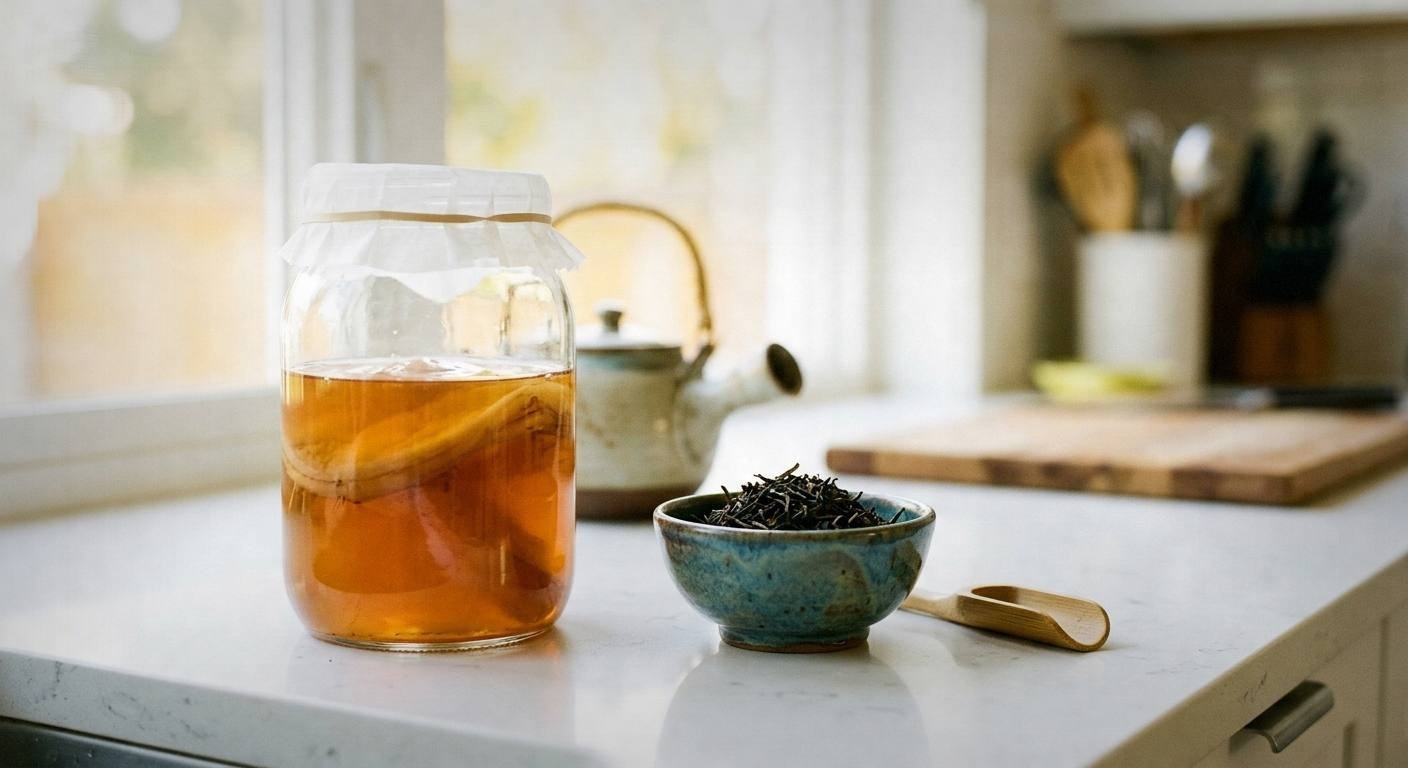
For a tea ferment, use the separately measured plain kombucha method . For a non-fermented drink to serve with food, choose from simple mocktails . For growing culinary ingredients, use the botanical garden guide ; garden availability does not validate a new fermentation formula.
These food processes do not provide a beet-drink method. The former TFA beet kvass procedure is under review , and its old brine directions should not be inferred from the vegetable recipes above.