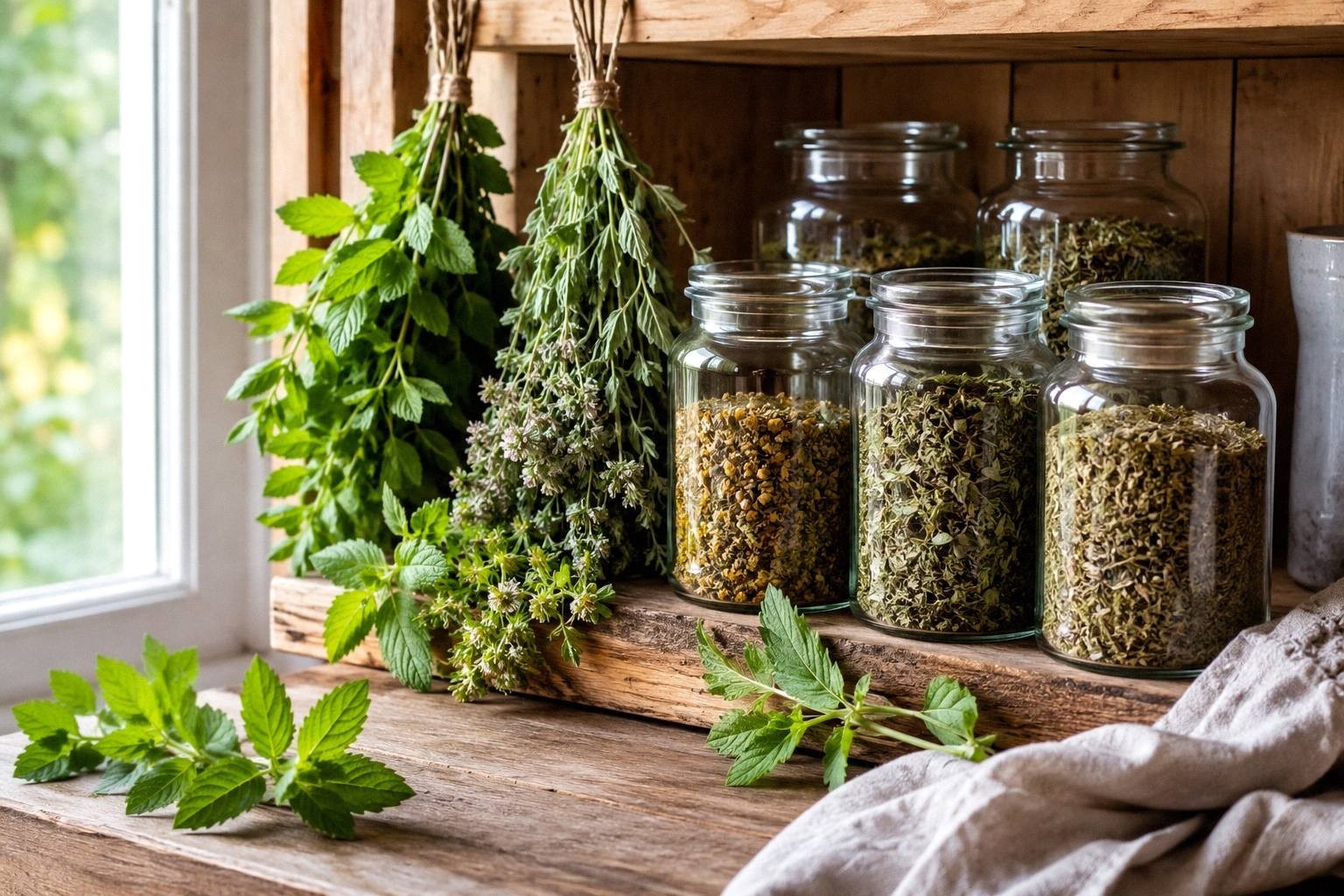
Dry tea herbs need airflow and a checked endpoint. Leaves that merely wilt can trap moisture in a sealed jar.
Choose Food Herbs and Harvest Carefully
Use positively identified culinary herbs grown for food. Drying does not make an unidentified plant edible or establish a medicinal dose. Avoid florist plants and herbs treated with products unsuitable for food crops. Handle stinging nettle with gloves and use a reliable food identification source; this is not a foraging guide. For a tea-garden guide to food-grown mint, chamomile, lemon balm and other herbs, see herbs you can grow for tea blends .
For most leafy herbs, harvest after dew dries and before flowering. Chamomile flowers and lavender buds have different harvest targets; select intact food-grown flowers or buds appropriate to that herb. Discard damaged material, rinse under cool running water and shake or pat away surface water. Label before drying.
Three Drying Methods
Air-drying
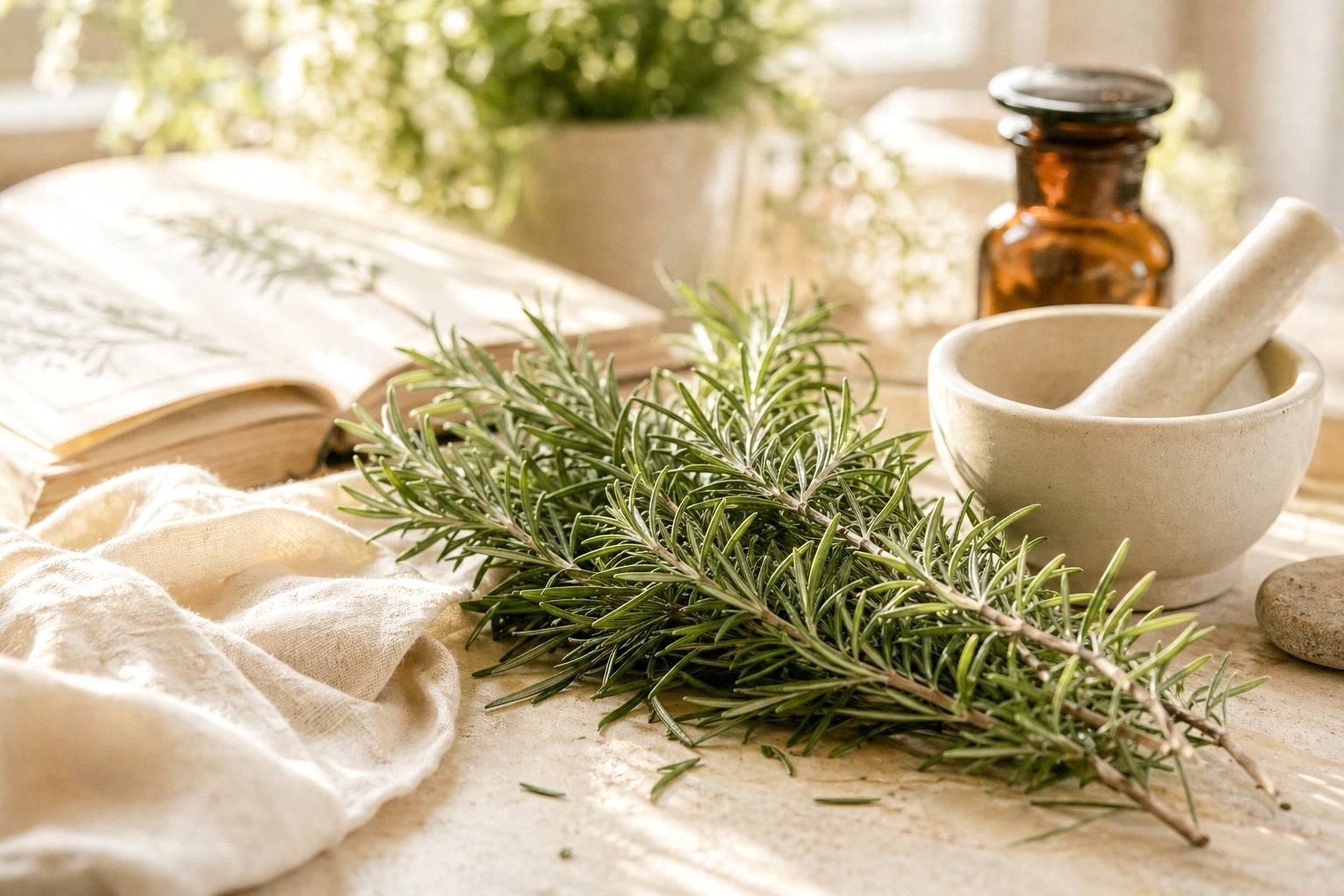
Woody rosemary, sage and thyme tolerate small loose bundles in a dry, ventilated place out of sun. Minnesota Extension suggests four or five stems and roughly 7 to 14 days. Treat that as an estimate, not a completion test.
Mint, lemon balm and tulsi (a basil) carry more moisture. Use a dehydrator in humid conditions. If air-drying tender leaves, use small bunches with good airflow and vented paper bags to catch falling leaves; discard moldy material. Do not pack damp leaves in a closed cupboard.
A cool oven
NCHFP describes individual leaves dried in a very cool oven with the oven light providing gentle warmth overnight. Use only a method permitted by your appliance instructions, with heat-rated trays and clear space around any light or heating element. Do not put paper near an active heating element. If the oven cannot provide a suitably gentle drying environment, choose a dehydrator. The earlier generic 140 F oven suggestion is not this source method.
Dehydrator
Spread rinsed, surface-dried material in a single layer without crowding. Follow the appliance’s herb instructions. NCHFP gives 95 to 115 F (35 to 46 C), with up to 125 F (52 C) in humid conditions, and an estimated 1 to 4 hours. Minnesota gives 2 to 6 hours at the lower range. Equipment, loading and herb moisture explain why elapsed time cannot establish dryness. Inspect periodically and continue until the whole batch is dry.
Check Dryness, Cool and Store
Leaves should crumble readily and stems should break when bent. Thick stems and dense flower centers need checking too; a dry outer petal is not a test of the center. Use small loose loads and the appliance’s flower guidance for chamomile and lavender. Cool the batch before sealing it in a clean, completely dry airtight container. Keep leaves whole and crumble them when needed.
Store in a cool, dry, dark cupboard. Label species and drying date. Minnesota’s up-to-one-year window is a storage/quality guide for fully dried herbs, not an herb-specific safety guarantee. Recheck jars for moisture. If condensation appears promptly and the batch has no spoilage, re-dry it and use a clean dry jar. Discard moldy, musty, insect-infested or uncertain damp batches; do not rely on aroma to prove safety.
| Herb | Practical drying choice | Storage target |
|---|---|---|
| Mint, lemon balm, tulsi | Dehydrator, especially in humidity; small well-ventilated bunches only when suitable | Use a dry, sound batch within about one year |
| Rosemary, sage, thyme | Small air-dried bundles or dehydrator | Same quality target |
| Chamomile flowers, culinary lavender buds | Loose single layer, species/appliance guidance, check dense centers | Same quality target |
| Correctly identified nettle | Gloves during fresh handling; dehydrator or suitable airflow | Same quality target |
| Lemongrass | Thinly cut food-grown blades, single-layer dehydrator, check all pieces | Same quality target |
Common Questions
Can I use a microwave?
Only if your microwave manual provides an herb-drying method. Follow its loading and timing instructions, watch continuously, and stop if scorching occurs. OSU warns against recycled paper towels because metal fragments can arc. Do not use the former universal 20-to-30-second prescription for every herb and appliance.
Does dried herb strength dictate how much tea to drink?
No. A cooking substitution or drying method does not establish a medicinal dose or suitability for every person. Use a complete culinary tea recipe or labeled product; this page adds no cold-brew or treatment instructions.
What yield should I expect?
Fresh loading and dried recovery vary. Measure the finished dry material if a later recipe needs a quantity. This preservation guide has no fixed beverage yield or food Recipe schema.