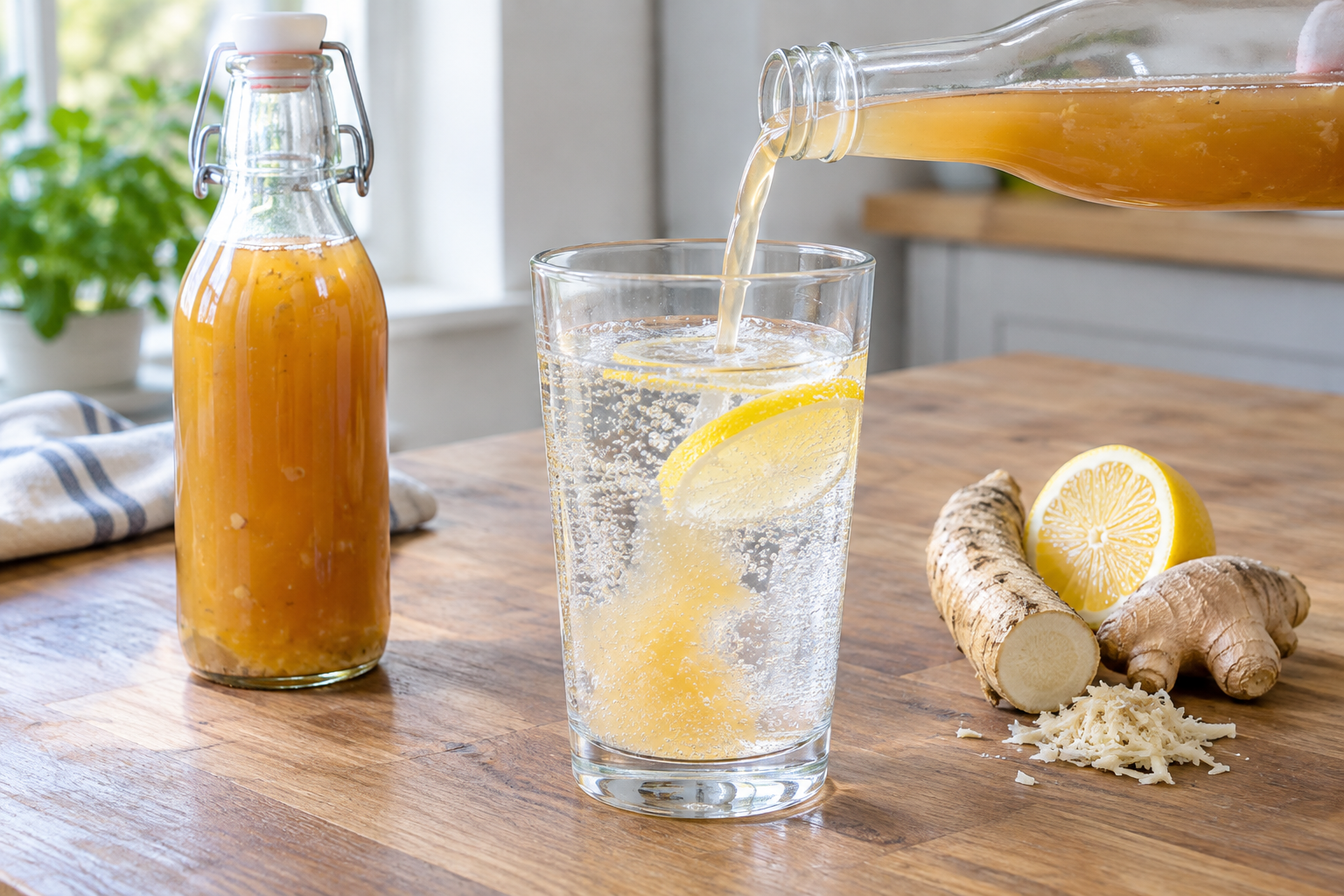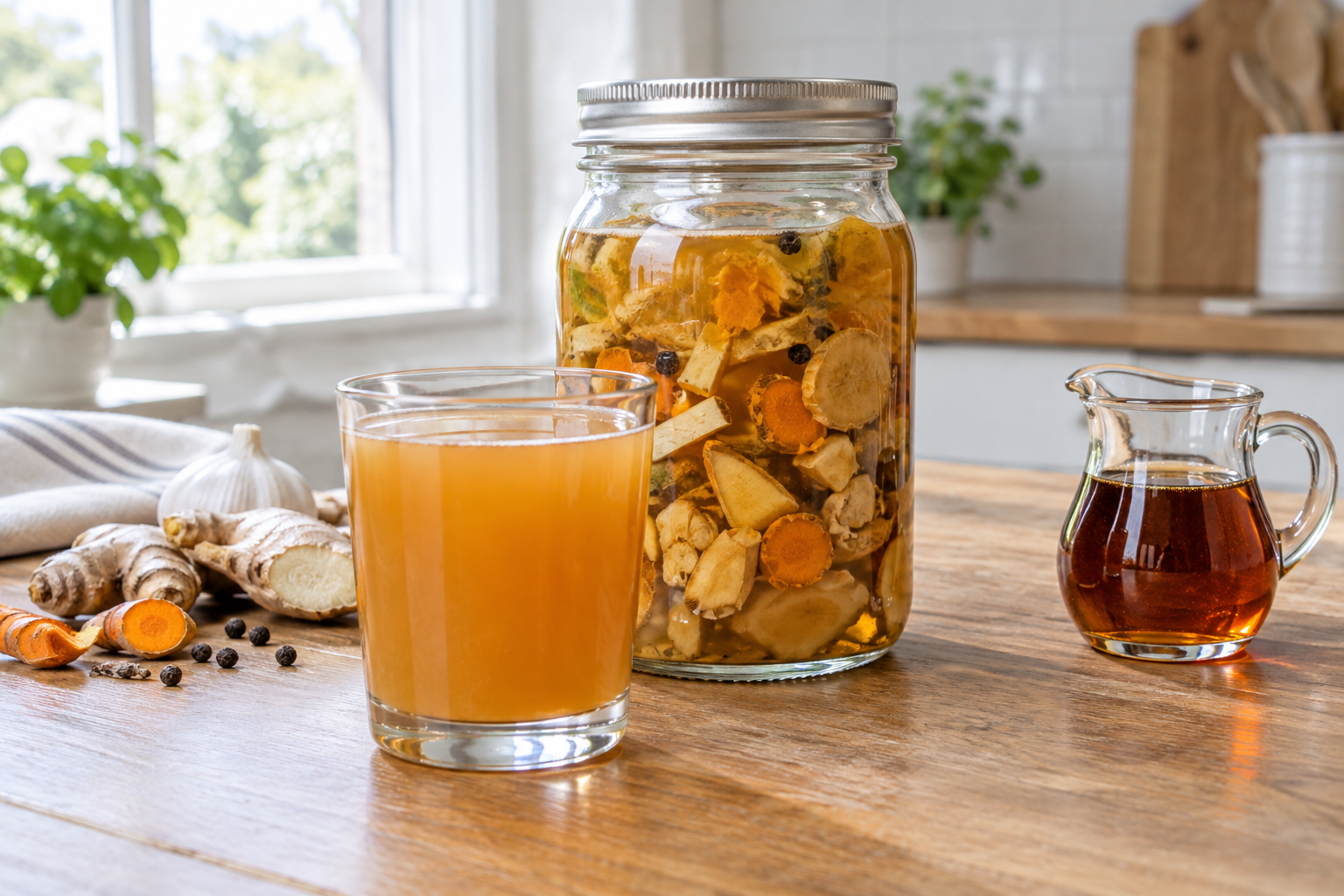
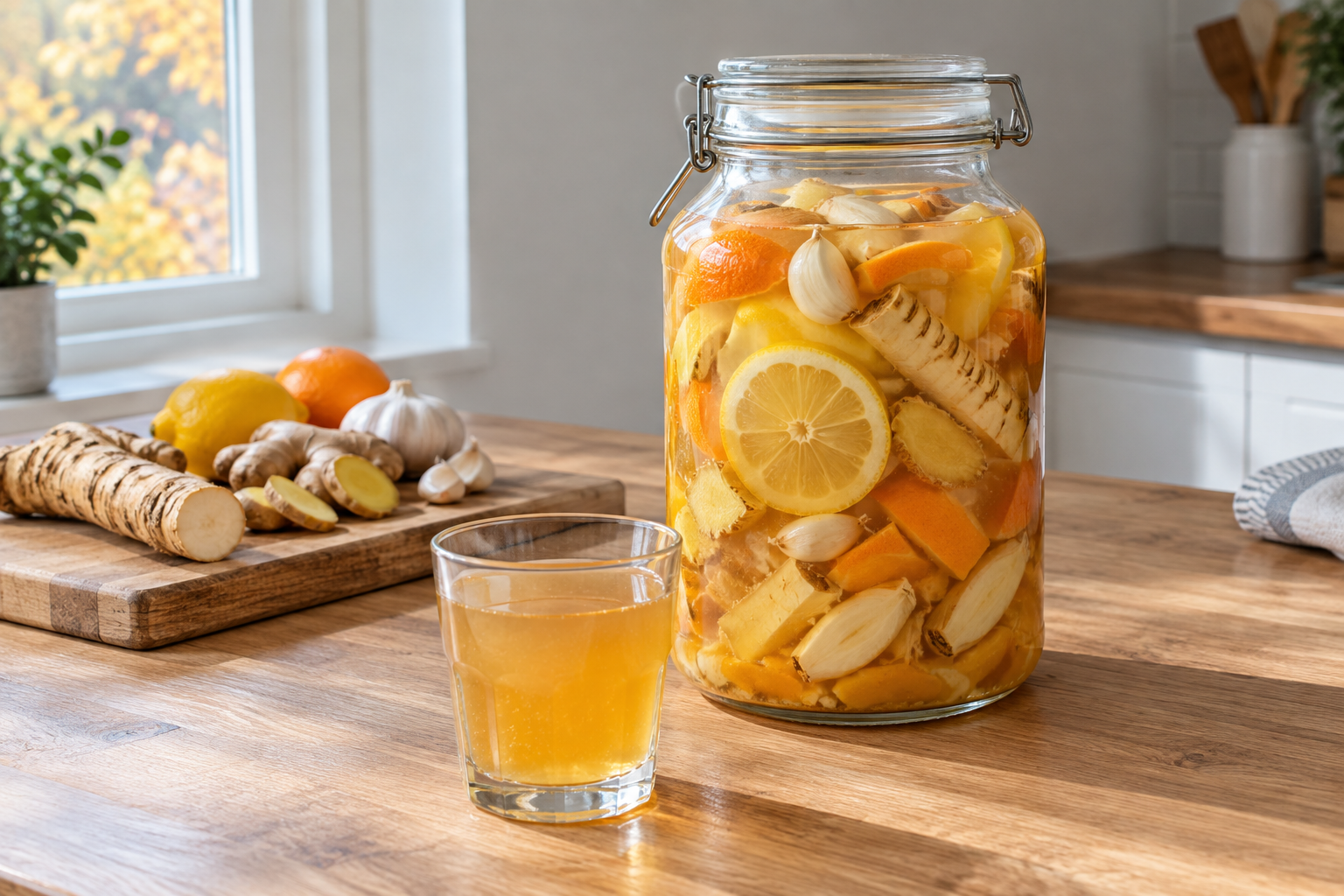
Fire cider is a traditional herbal tonic made by infusing horseradish, ginger, garlic, and citrus in raw apple cider vinegar for 3-4 weeks. Strain and keep it in the fridge.
Fire cider with horseradish, ginger, garlic, turmeric, and apple cider vinegar. Infuses in 3 to 4 weeks into a hot, sharp, pungent tonic.
Why You Will Love This
Fire cider hits your palate like a wake-up call. Sharp horseradish, warming ginger, pungent garlic, all mellowed by the tang of raw apple cider vinegar and a touch of honey. This traditional herbal wellness tonic isn’t subtle, but that’s the point. It is one of the loudest things you can keep in a fridge door, and people who make it once tend to keep a jar going every winter after that.
The Story Behind It
Fire cider has been a staple in herbalist kitchens for generations, though its exact origins remain wonderfully murky. What we know is this: folk healers have long combined pungent roots and aromatic spices in vinegar to make warming tonics, and herbalists have kept a jar going through the cold months for about as long as anyone has written any of it down. The recipe adapts beautifully to what you have on hand, making it a living tradition rather than a rigid formula.

What You Will Need
- 1 medium horseradish root, peeled and chopped (about 1/2 cup)
- 1/2 cup fresh ginger root, peeled and chopped
- 1 head of garlic, cloves peeled and roughly chopped
- 1 medium onion, roughly chopped
- 2 tablespoons fresh turmeric root, chopped (or 1 tablespoon dried)
- 1 lemon, sliced
- 1 orange, sliced
- 2-3 sprigs fresh rosemary
- 1 tablespoon whole black peppercorns
- 1/4 teaspoon cayenne pepper (or to taste)
- Raw apple cider vinegar with the mother (enough to cover, about 3-4 cups)
- 1/4 cup raw honey (for finishing)
Equipment:
- 1-quart glass jar with lid
- Fine mesh strainer or cheesecloth
- Storage bottles
How to Make It
Place all the chopped roots, aromatics, citrus, herbs, and spices into your glass jar. Pack them in loosely, leaving about an inch of headspace at the top.
Pour raw apple cider vinegar over the ingredients until everything is completely submerged by at least an inch. The vinegar must cover all plant material to prevent mold.
Cap the jar tightly. If using a metal lid, place a piece of parchment paper between the lid and the jar to prevent corrosion from the vinegar.
Shake well and label with the date. Store in a cool, dark place for 3 to 4 weeks, shaking the jar daily or whenever you remember.
After the infusion period, strain the fire cider through a fine mesh strainer or cheesecloth, pressing on the solids to extract every drop of liquid.
Stir in the honey until fully dissolved. Taste and adjust sweetness if needed.
Pour into clean glass bottles and store in the refrigerator. Your fire cider will keep for several months.

Herbalist Notes
Horseradish and garlic are where the sulfur compounds live, and those compounds are the reason both of them punch you in the sinuses. They are the heat and the bite here, the elements that make fire cider live up to its name. Fresh grated horseradish is far stronger than the jarred kind, so a big fresh root will give you a fierce jar.
Ginger and turmeric are the warmth underneath. Both roots have been kitchen staples across traditional cooking and herbalism for centuries, and in this jar they round out the sharper edges and give the finished vinegar its colour.
Apple cider vinegar with the mother is the traditional base and the thing doing the extraction. It is also what the whole preparation is built on, which is why the fix for a batch that comes out too strong is more base vinegar rather than water.
Herbalists have traditionally kept a bottle going through the cold months and taken it by the spoonful, straight or stirred into hot water. How much and how often is a personal habit rather than a prescription, and if you are on medication or pregnant it is worth asking your doctor before you start. Most people cut it with something at the point of pouring: warm water and lemon, sparkling water and lime, apple juice, or tomato juice.
Make It Your Own
Add fresh jalapeños for extra heat, or mellow the intensity with more citrus. Some makers include fresh thyme or oregano for additional aromatic complexity. You can also experiment with the sweetener: maple syrup creates a different flavor profile than honey, while some prefer their fire cider unsweetened altogether.
Dilute a tablespoon in sparkling water with a squeeze of lime for a zingy wellness drink, or use it as a base for salad dressings and marinades. Fire cider makes an excellent gift when bottled in small jars with handwritten labels explaining its use.

Fire Cider Guides
Four questions come up more than any others once a jar is going. Each one has its own guide:
- When to strain fire cider covers the three to four week window, how to taste a vinegar without wrecking your palate, and the straining method.
- How long does fire cider last covers fridge versus pantry storage, the quality window, and the signs a bottle should go down the drain.
- Fire cider without honey covers maple, agave, and unsweetened batches, and what each one changes in taste and body.
- Fire cider too spicy covers taming a harsh batch, where the heat actually comes from, and how to build a gentler jar next time.
Common Questions
Does fire cider actually work?
Every ingredient in the jar is a kitchen heavyweight with a long history. Garlic carries allicin, the compound behind that unmistakable smell, and it has been a household staple of folk cooking everywhere garlic grows. Ginger is the oldest warming root in the cupboard. Horseradish turns up all through the old herbals, and anyone who has eaten a spoonful of the fresh grated root knows exactly why it made an impression. Apple cider vinegar with the mother is the traditional base.
Nobody has run a trial on fire cider as a finished thing, and I would be suspicious of anyone who told you otherwise. What it is, undeniably, is a very hot, very sour, very alive spoonful that wakes you up on a January morning. People keep making it. That is the honest evidence, and it is a real kind.
How do people actually use fire cider?
Rarely neat. A spoonful stirred into warm water with lemon is the classic winter version, and it is the one that softens the horseradish edge fastest. Beyond that it goes into sparkling water with lime, tomato juice, apple juice, vinaigrettes, marinades, and pan sauces. How much and how often is a personal habit, and if you are on medication or pregnant, ask your doctor before you start. If your batch is too fierce to enjoy in any of those, see fire cider too spicy.
How long does homemade fire cider last?
Keep the strained bottle tightly sealed in the refrigerator. Oregon State University Extension’s guidance for flavored vinegars, which is the category this falls into, is to use them within 4 to 6 months for best quality and to taste before using after six months. Discard any bottle that molds or shows bubbling, cloudiness, or sliminess. Write the date on the bottle when you strain it. Full detail is in how long does fire cider last.
Can you make fire cider without apple cider vinegar?
Apple cider vinegar is the traditional base, and its mellower tang suits the roots better than anything else I have tried. Raw white wine or red wine vinegar will extract in much the same way, with one caveat worth knowing: Oregon State University Extension notes that wine and rice vinegars contain proteins that promote bacterial growth if the vinegar is not handled and stored properly, and advises using only commercially produced vinegars for added safety. Penn State Extension’s page on flavored vinegars gives the same warning and says to keep those refrigerated and use them quickly. Plain distilled white vinegar works but is harsher. Rice vinegar is too mild to stand up to horseradish. A glycerin extraction is possible if you want no vinegar at all, but it makes a very different product and keeps differently.
Is fire cider safe during pregnancy?
Ask your midwife or OB. That is the whole answer, and it is not a dodge. Fire cider is a concentrated tonic rather than a culinary amount of anything, and the only person who should be weighing that up for your pregnancy is the one managing your care.
When to Serve and Pairings
This tonic works best as a small ritual drink: fresh enough for daytime, but still useful when you want something more intentional than water.
Perfect occasions include:
- Morning prep
- Afternoon reset breaks
- Post-garden cleanup
- Light brunches
- Meal-prep days
- Quiet weekend routines
Food pairings:
- Greek yogurt with fruit
- Seeded toast
- Simple grain bowls
- Citrus salads
- Soft scrambled eggs
- Roasted vegetables
Tonic-style drinks pair best with simple food because strong spices, heavy sauces, or too much sugar can bury the botanical notes.
Printable recipe
Fire Cider Recipe: Horseradish, Ginger and Garlic in Apple Cider Vinegar
Fire cider with horseradish, ginger, garlic, turmeric, and apple cider vinegar. Infuses in 3 to 4 weeks into a hot, sharp, pungent tonic.
Ingredients
- 1 medium horseradish root, peeled and chopped (about 1/2 cup)
- 1/2 cup fresh ginger root, peeled and chopped
- 1 head of garlic, cloves peeled and roughly chopped
- 1 medium onion, roughly chopped
- 2 tablespoons fresh turmeric root, chopped (or 1 tablespoon dried)
- 1 lemon, sliced
- 1 orange, sliced
- 2-3 sprigs fresh rosemary
- 1 tablespoon whole black peppercorns
- 1/4 teaspoon cayenne pepper (or to taste)
- Raw apple cider vinegar with the mother (enough to cover, about 3-4 cups)
- 1/4 cup raw honey (for finishing)
- 1-quart glass jar with lid
- Fine mesh strainer or cheesecloth
- Storage bottles
Instructions
- Place all the chopped roots, aromatics, citrus, herbs, and spices into your glass jar. Pack them in loosely, leaving about an inch of headspace at the top.
- Pour raw apple cider vinegar over the ingredients until everything is completely submerged by at least an inch. The vinegar must cover all plant material to prevent mold.
- Cap the jar tightly. If using a metal lid, place a piece of parchment paper between the lid and the jar to prevent corrosion from the vinegar.
- Shake well and label with the date. Store in a cool, dark place for 3 to 4 weeks, shaking the jar daily or whenever you remember.
- After the infusion period, strain the fire cider through a fine mesh strainer or cheesecloth, pressing on the solids to extract every drop of liquid.
- Stir in the honey until fully dissolved. Taste and adjust sweetness if needed.
- Pour into clean glass bottles and store in the refrigerator. Your fire cider will keep for several months.
Keep browsing