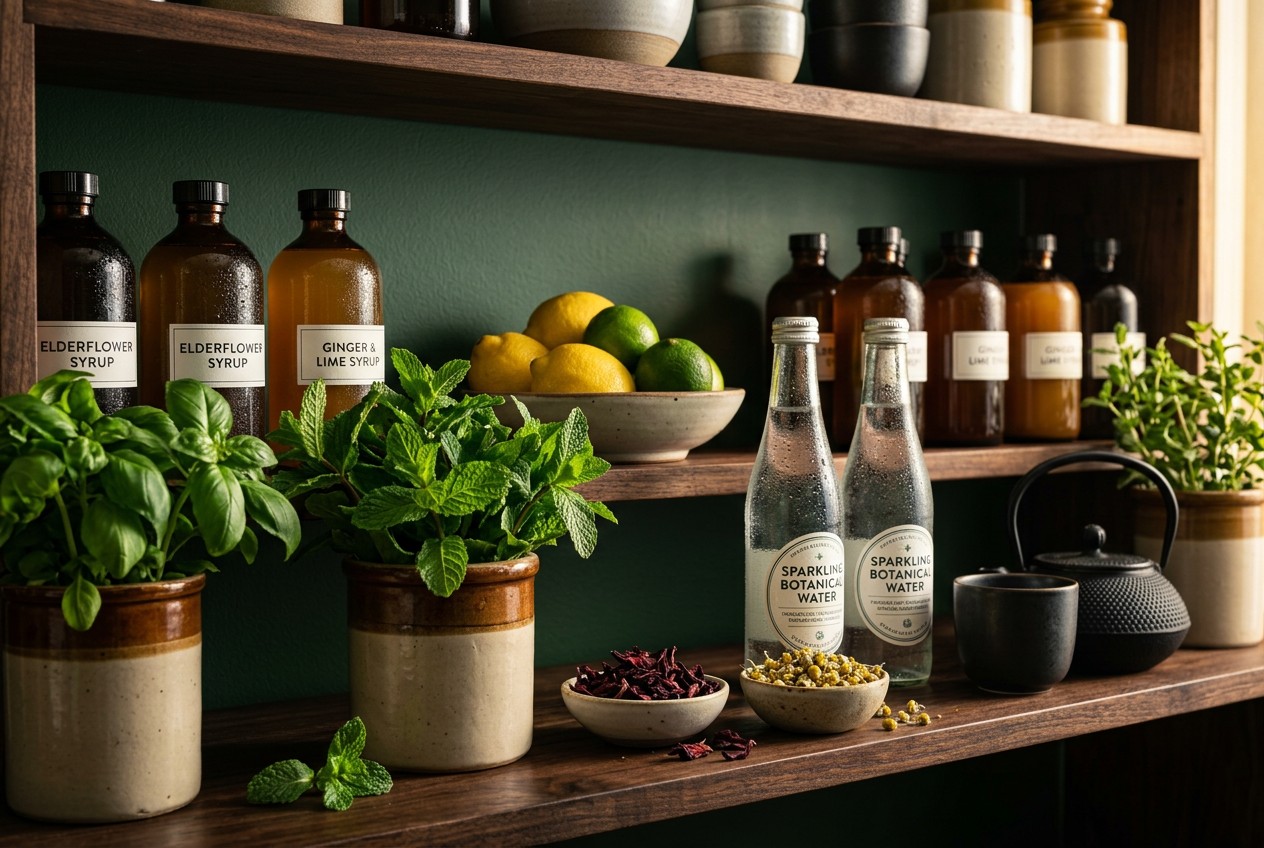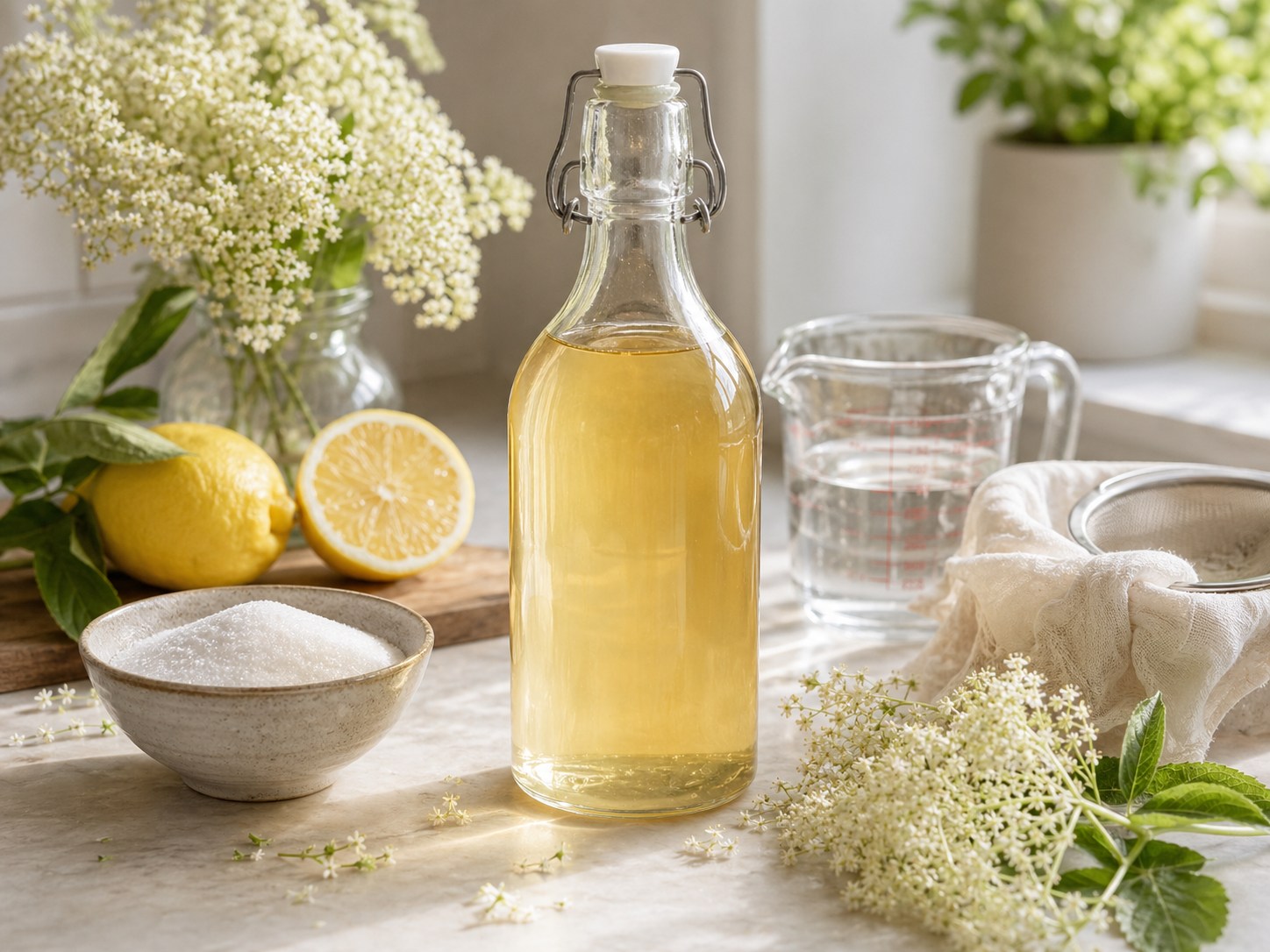
Elderflower cordial is a sweet floral concentrate, not a ready-to-drink lemonade. This repair uses Jane Hornby’s complete measured ingredient formula as a culinary comparison. TFA explicitly adapts its infusion to refrigeration and does not inherit the published six-week storage promise.
Ingredients and Timing
- 20 fresh flower heads from confidently identified edible Sambucus nigra, food-grown; all stalks removed
- 2.5 kg granulated sugar
- 1.5 litres potable water
- 2 unwaxed lemons, rinsed, zest pared and fruit sliced
- 85 g food-grade citric acid, weighed
The source planning yield is about 4 litres; measure actual strained output, since flowers absorb syrup and extraction conditions differ. Provide containers for at least that volume rather than claiming the former three cups. The former 2 cups sugar/2 1/2 cups water/optional citric-acid formula is a different syrup, with no established two-week shelf life.
Allow 20 minutes active prep, about 10 minutes heating, around 30 minutes rapid cooling, then a separate 24-hour refrigerated infusion and straining: plan about 25 hours total, longer if heating/cooling takes longer. Refrigeration is a handling adaptation, not a tested preservation process.
Method
- Use confidently identified food elderflowers; reject unknown or sprayed plants. Remove stalks and leaves; rinse gently under running water and drain. Use clean equipment and a heat-safe vessel of at least 6 litres.
- Heat water and sugar together, stirring until dissolved; bring syrup to a boil and remove from heat.
- Add trimmed flowers, prepared lemons and weighed food-grade citric acid. Stir, divide carefully into small heat-safe containers and cool promptly in an ice bath; keep bath water out.
- Cover and refrigerate at 40 F (4 C) or below for 24 hours after cooling, rather than steeping on the counter. Strain through a clean cloth-lined sieve without forcing plant solids through.
- Measure actual strained output. Transfer to clean food containers sized for the yield and keep refrigerated. Use the finished portion that day and freeze extra with expansion space. This is not a shelf-stable canning process.
Do not use white flowers on the basis of color alone. Species and edible parts must be confirmed; a short web description is not identification. Leaves, stems, bark, roots and raw berries are not cordial ingredients. Washing reduces surface contamination but cannot clear an unknown plant or pesticide treatment. Citric acid is measured food-grade powder, not lemon juice, cleaning acid or a guarantee of finished pH.
Measured Serving Options
For a spritz use 1 tablespoon cordial with 6 fluid ounces sparkling water in a 12-fluid-ounce glass over ice; stir gently at service. The liquid is 6 1/2 fluid ounces before ice. For the lemon version add 1 tablespoon lemon juice, giving 7 fluid ounces. Add one rinsed mint leaf or one ribbon cut from a scrubbed cucumber if desired.
For lemonade or prepared chilled tea, start with 1 tablespoon cordial in 6 fluid ounces drink, replacing rather than automatically adding its other sweetener. These are house serving choices, not fixed sweetness equivalents. Black and green tea contain caffeine. For a cocktail add 1 fluid ounce gin to the standard spritz, use a larger glass if needed and identify it as alcoholic.
Lime Cordial
Replace one lemon with one rinsed unwaxed lime; retain all other quantities, including weighed acid and the same cold method. Yield remains measured. This is a house citrus substitution, not validated preservation.
Mint Cordial
Add 10 rinsed fresh culinary mint leaves for only the last two hours of the 24-hour refrigerated infusion; strain with the flowers. The total rest stays 24 hours, not 26. Individual mint-leaf size affects flavor.
Honey Cordial
For a house flavor variation replace 100 g of the sugar with 100 g mild honey , retaining 2.4 kg sugar, 1.5 litres water and the other ingredients. Add honey off heat before cooling; sweetness, solids and volume differ from sugar. Use the same cold infusion and day-use/freezer handling. The former half-cup exchange was not a preservation equivalence.
Storage and Review Limits
Refrigerate promptly in small clean containers at 40 F (4 C) or below. Discard after more than two cumulative hours without cold holding, or one hour above 90 F (32 C). Do not wait for a large batch to cool on the counter. Normal smell and appearance do not establish safety. After the specified 24-hour extraction and straining, use the finished portion that day and freeze extra. Keep chilled extraction and finished-use plans distinct. Discard suspected spoilage or fermentation; normal taste, clarity or lack of a hiss does not establish safety. Do not pressure-bottle or can this house adaptation. No medical claims, kitchen, pH, microbial or shelf-life testing are made.